[cross-posted at Liberty & Power]
Montaigne himself, whose subtle candor disestablished
authority as the weather brings down a stone wall ….
– Isabel Paterson
Outside of libertarian circles, the 16th-century essayist Étienne de la Boétie is best known (when he is known at all) as the “friend of Montaigne” – that is, the friend Montaigne praises so extravagantly in his essay “On Friendship.”
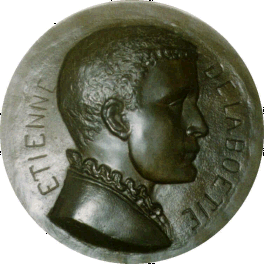 Within libertarian circles, of course, La Boétie is best known as the author of the brilliant libertarian treatise Discourse of Voluntary Servitude; Rothbard, for example, describes La Boétie as the “one of the seminal political philosophers” and the “first theorist of the strategy of mass, non-violent civil disobedience,” and credits him with originating the “fundamental insight … that every tyranny must necessarily be grounded upon general popular acceptance.”
But did La Boétie actually write it?
Two recent books argue that Montaigne, rather than La Boétie, was probably the actual author of the Discourse, and that at the very least he was both sympathetic to its message and somehow involved in its composition: The Political Philosophy of Montaigne (henceforth PPM), penned by David Lewis Schaefer, and an anthology, Freedom Over Servitude: Montaigne, La Boétie, and On Voluntary Servitude (henceforth FOS), edited by the same Schaefer. (Amazon lists the latter work at a daunting $130, but I had no trouble finding a used copy online for $20.)
Now it must be said up front that Schaefer is a “Straussian” – that is, a follower of Leo Strauss – as are a number of contributors to his anthology. Straussians tend to approach philosophical texts with the assumption that the authors are likely to have disguised their true views, or hidden them in coded messages, in order to avoid getting into trouble with political or religious authorities; thus any apparent tension in the surface of the text is quickly seized upon as evidence of a deeper meaning contradicting the surface meaning.
While I agree with the Straussians that alertness to the possibility of prudent dissimulation is a useful tool for interpreters, in my judgment Straussians are so quick to read apparent tensions as genuine contradictions, and genuine contradictions as intentionally inserted clues, that they routinely underestimate the value and subtlety of the so-called surface reading. As a result, Straussian interpretations become (IMHO) almost entirely unresponsive to and dismissive of the actual texts they are supposed to be explicating; subtle distinctions the authors are trying to make are ham-handedly misread as contradictions, and the Straussians end up mostly imposing on a rich variety of texts a preconceived, blandly uniform set of Straussian ideas that every great thinker “must” naturally have accepted, rather than opening themselves to an engagement with the ideas the authors actually claim to be propounding. Thus I find the standard Straussian readings of, for example, Plato, Xenophon, Descartes, and Locke, almost completely worthless. (I agree with them that Xenophon is a much sharper philosopher than he’s traditionally been give credit for – but my reasons are virtually the opposite of theirs. The Straussians, like Xenophon’s critics, find the surface of Xenophon’s text to be a mass of contradictions; unlike the critics, they quickly dive below the surface to find the deep meaning. Contra both the Straussians and the critics, I think the surface of Xenophon’s text is just fine as it is, and the supposed contradictions are mainly the product of impatience, or a tin ear, on the reader’s part.)
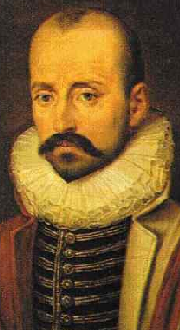 Interpreting the apparently conservative Montaigne as a secret radical is a paradigmatically Straussian thing to do; in light of (what I take to be) the weaknesses of the Straussian “esoteric” approach to textual interpretation, Schaefer’s thesis must thus be approached with caution. Nevertheless, I think Schaefer et al. are on to something. If ever a philosopher called out to be given a Straussian reading, it is Montaigne, who often seems to be deliberately drawing the reader’s attention to the fact that some piously conservative remark he’s uttering now is flatly inconsistent with some radical remark he made two chapters earlier. In particular, what Montaigne has to say about La Boétie is very odd (more about this below). Moreover, La Boétie’s own later advocacy of religious persecution is hard to square with his earlier enthusiasm for liberty and rebellion. After finishing these two books I went back and slogged through Montaigne’s entire massive Essays (1269 pages in my edition – that’s why it’s taken me a while to blog about it; and I haven’t even tackled the letters and journals yet!) while keeping the arguments of Schaefer et al. in mind; the result is that while I’m not 100% convinced that Montaigne wrote the Discourse, I now think it an extremely plausible hypothesis – and I am convinced that Montaigne’s thought has far more affinity with the radical libertarianism of the Discourse than has hitherto been recognised. (One of the fruits of this reading was my earlier post defending Montaigne against Mises’ charge of holding that economic exchange must always be zero-sum.)
Shaefer’s interest in the Discourse may be motivated by libertarian sympathies of his own; at any rate he refers favourably to Milton Friedman and Friedrich Hayek, and the writing of PPM was funded by the libertarian-oriented Earhart Foundation. On the other hand, Schaefer has apparently written a book attacking John Rawls for being too libertarian (!), so go figure.
To give you some idea of my reasons for favouring the Schaefer thesis, I excerpt below some notes I’ve been making on Montaigne for a course on political philosophy I’ll be teaching in the spring:
Montaigne – no doubt owing to the rambling, unsystematic character of his writings – receives little attention nowadays from professional philosophers, but he was once enormously influential; echoes of his ideas turn up frequently in Shakespeare, Descartes, Pascal, Voltaire, Rousseau, Hume, and Emerson, among others. And if, as a number of recent scholars have argued (though the thesis is far from proven), Montaigne was secretly the author of the Discourse on Voluntary Servitude which he attributes to his friend Étienne de la Boétie, then he also exercised a crucial influence on Lammenais and Tolstoj, and thus indirectly on Gandhi and M. L. King.
Montaigne’s political intentions, like his philosophical intentions generally, are difficult to ascertain. An admirer of the Greek skeptics, he often borrows their custom of arguing both sides of a case – but his intentions in doing so are not always clear. In one essay he hails obedience as the primary virtue; then in another he praises to the skies La Boétie’s call for revolutionary disobedience. He praises ignorance, and praises learning; he alternately defends and criticises both Christianity and paganism, both frankness and dissimulation, both monarchy and democracy; he advocates numerous reforms, and also counsels leaving existing institutions as they are. He expresses gratitude for governmental authority, warning that in its absence we would all turn cannibal (though the passages he cites from Plato and Plutarch for this claim are actually about how people would not need government if they were sufficiently wise and virtuous); yet when he discusses real-life cannibals in the New World, whom he describes as living without governmental authority, he paints a glowing portrait of their lifestyle as superior to that of civilisation. A life of primitive simplicity is recommended because it would make the job of governing us easier – but it is also recommended because it would make the job of governing us neither necessary nor possible. …
Some scholars have seen Montaigne’s opening remark that he would have portrayed himself “quite fully and quite naked” if he had lived in a country that enjoyed “the sweet liberty of primitive laws of nature” as the author’s way of hinting that he is hiding his true views to avoid persecution/prosecution. …
In Essays I. 28, Montaigne begins by promising to include La Boétie’s Discourse of Voluntary Servitude in its entirety; he also tells us that he and la Boétie were of one mind on everything, and that La Boétie’s Discourse is so much greater than all of Montaigne’s Essays that it deserves to be the centerpiece to which the Essays are mere decoration. All this looks like a pretty enthusiastic recommendation of the Discourse (and a surprising recommendation, given the apparent contrast between the Discourse’s praise of disobedience and Montaigne’s own frequent praise of obedience).
But Montaigne ends by saying that the Discourse is merely a schoolboy exercise of no great originality or importance, and that he has decided not to include it after all, since people might wrongly conclude from it that its author favoured disobedience to the government. (Montaigne made many changes in the Essays through multiple subsequent editions, yet this statement of an intention to include the Discourse, followed by Montaigne’s “changing his mind,” remained unchanged in each edition.) Montaigne assures us that, on the contrary, La Boétie would never have dreamed of advocating disobedience – though he also assures us that La Boétie was sincere in what he wrote in the Discourse (which is of course one long hymn to disobedience). How to make sense of all this is a puzzle. …
La Boétie’s Memoir on the Edict of January 1562 was an ultra-authoritarian document advocating state terrorism against religious dissenters; as such it was as far opposed to the vehemently anti-authoritarian Discourse on Voluntary Servitude as could be imagined; many scholars have suspected that the Memoir and the Discourse were not in fact written by the same person, and that if the historical La Boétie was the author of the Memoir, then perhaps Montaigne was the author of the Discourse. Some passages in Montaigne’s prefaces to La Boétie’s works have in fact been taken to imply this; such phrases as “a man whose like I never met with” and “whom I can hardly, by the utmost stretch of my imagination, conceive a superior to” (the latter echoing Anselm’s definition of God) might be a hint that Montaigne’s La Boétie is a fictional persona, while “you [the reader] are indebted to me [Montaigne] for all you enjoy of the late M. Étienne de la Boétie” might likewise be a hint at Montaigne’s actual authorship, as again might Montaigne’s insistence in Essays I. 28 that he and La Boétie were two souls in one body, and that the Discourse really belongs in the Essays, indeed as its centerpiece. …
La Boétie’s political intentions are perhaps as enigmatic as Montaigne’s. Only two of his surviving works bear directly on politics – the Discourse on Voluntary Servitude and the Memoir on the Edict of January 1562. Each work seems straightforward and unambiguous, taken separately; but the two sit oddly together. As mentioned above, the Memoir is thoroughly authoritarian while the Discourse – a radical essay on the nature, techniques, and limits of political power – is thoroughly anti-authoritarian. According to Montaigne the Discourse was written over a decade before the Memoir, so perhaps the discrepancy can be explained as one more instance of the familiar phenomenon of youthful radicals turning conservative and respectable in later years.
As noted previously, though, La Boétie’s authorship of the Discourse has been disputed. Our only source of information as to La Boétie’s being the author of the Discourse (or of the Memoir, for that matter) is the testimony of Montaigne, but not everything Montaigne tells us about La Boétie’s authorship can be accurate; for he says that La Boétie wrote the Discourse as a teenager and never subsequently edited it (or so Montaigne implies in saying that La Boétie “never saw it after it first went out of his hands”), yet the Discourse contains references to events that occurred only after La Boétie was no longer a teenager. Some scholars hypothesise that Montaigne backdated La Boétie’s composition of the Discourse to downplay its significance, on the theory that the censors would find it less alarming if they thought it was a mere schoolboy exercise; other scholars have suspected that the Discourse was actually the work of Montaigne himself, or at least significantly edited by Montaigne, and that he passed it off as the work of his deceased friend in order to avoid prosecution for its subversive content.
Montaigne also tells us both that La Boétie was committed “very religiously to obey and submit to the laws under which he was born” and that “he himself believed what he wrote” – which might be yet another hint that the Discourse was not one of the things that La Boétie wrote, since no one could simultaneously be committed to obedience and also believe the message of the Discourse (which is disobedience from start to finish).
Despite, however, my sympathy with Schaefer et al.’s case for a connection between Montaigne and the Discourse, I find some of their arguments – well, just plain awful. For example:
 The contrast between the authoritarianism of La Boétie’s later Memoir and the anti-authoritarianism of the earlier Discourse is certainly some evidence in favour of the claim that La Boétie did not write the latter work; but it is hardly as decisive as Schaefer et al. seems to suppose. Schaefer says that the opposition between the two works is “inexplicable” except on the assumption that they were written by different people (FOS, p. 27), while Daniel Martin, one of the contributors to FOS, opines that they “cannot have been written by the same person, because they embody irreconcilable political positions.” (p. 148.) Have Schaefer and Martin never heard of authors changing their minds? The phenomenon of a youthful radical becoming more conservative with age is not exactly unprecedented; should we likewise assume that Burke could not have written both the Vindication and the Reflections, or Fichte both On the French Revolution and Addresses to the German Nation, or David Horowitz both Corporations and the Cold War and The Anti-Chomsky Reader?
Just as religious authors once used to assume that no intelligent person could sincerely be an atheist, so Straussians tend to assume that no intelligent person could sincerely be a theist; hence Straussians are constantly on the lookout for coded atheist messages in purportedly theist texts. Of course, if one is determined to find a certain kind of message, one will find it. Schaefer et al. read the Discourse this way, and accordingly conclude that God is the tyrant the Discourse is talking about, the one whose power will vanish if we stop obeying him.
Their evidence? Here’s a sample. Michael Platt, another contributor to FOS, notes that “by not qualifying ‘Tyran’ – by for example adding ‘homme’ – La Boétie indicates that tyrants are not limited to the class of human beings; they may be other beings, spirits, divinities, or God.” (p. 62.) Platt oddly neglects to mention prairie dogs. Moreover, the Discourse’s phrase “how many men and cities and nations suffer under a single tyrant” must, according to Platt, be a reference to God, because no human tyrant rules all these different communities! (If the text had said “how many different people have suffered from inflammation of the liver,” no doubt Platt would assume that there was one single liver that all these people shared.)
As further evidence, Schaefer and Platt point to the Discourse’s claim that the Jews are the only people so debased as to have imposed a tyrant on themselves without any apparent need. (FOS, pp. 20, 62-63, 200) One might have thought this was an obvious reference to 1 Samuel 8: 4-20, viewed through the lens of traditional antisemitism. But for Schaefer and Platt it can only be a reference to Jewish monotheism. (Schaefer oddly mentions 1 Samuel 9-10, but not the famous, and more relevant, 1 Samuel 8.)
Platt shores up this interpretation with what seems like a shifty maneuver; he makes a great deal of the fact that the word “One,” in reference to the tyrant, is capitalised in the original text – and so, he infers, must be a reference to God. (FOS, pp. 20-21.) Indeed it is capitalised; but in the same passage the words “City” and “Nation”are also capitalised. Platt’s translation quietly drops the initial capitals on these words while keeping them on “One,” thus artificially exaggerating the significance of the latter. Moreover, in the same passage the Discourse also refers to the “thirty Tyrants” of Athens; this capitalisation of tyrants plural seems awkward for Platt’s thesis of apotheosis by capitalisation. This time Platt does not drop the capital on “Tyrants,” but instead he adds one to “Thirty,” thus giving the impression that “Tyrants” is capitalised because it’s part of a traditional title rather than because the author is free with capitals.
Randolph Runyon works his Straussian magic on La Boétie’s sonnets:
But in the twenty-nine sonnets the actual center does not appear in the apparent center. That is, it does not appear in the middle of the fifteenth sonnet. Yet it is not at all that hard to find. The total number of syllables can be determined by adding the sum of decasyllables (14 sonnets × 14 lines × 10 syllables = 1960 syllables) and that of alexandrine syllables (15 sonnets × 14 lines × 12 syllables = 2520 syllables): 4480 syllables. The two central ones are thus the 2240th and the 2241st. (FOS, p. 100.)
These turn out to be the two syllables of “rien,” meaning “nothing”; thus nothing is “precisely what can be found at the center of this center.” If you like this sort of thing, rejoice – there’s plenty more; one expects the Templars to make an appearance at any minute. (And Daniel Martin’s article offers a visual equivalent of the same approach.) If you don’t like this sort of thing, and think Runyon is making heavy weather over meaningless coincidences, you will be solemnly informed (p. 103) that you are violating Ockham’s Razor (a principle of which Runyon obviously has a somewhat eccentric understanding).
There’s more. Platt mysteriously says that “Montaigne is the first philosopher since Socrates to give an account of his life” (FOS, p. 81), thus dropping Augustine and Abélard down the memory hole; but for a Straussian perhaps they do not count as philosophers? He adds that the fact that Montaigne hid his views to satisfy the censors shows that Montaigne approved of censorship! (FOS, p. 73.) And in a typically Straussian flight of lunacy, Schaefer takes Montaigne’s denial that he has made any unintentional errors as evidence that such errors as we do find must be intentional! (PPM, p. 260.)
They also, naturally, miss the whole point of the central argument of the Discourse. For example, in response to Montaigne’s suggestion that the populace might freely switch back and forth between democracy and monarchy depending on what they took circumstances to call for, Schaefer expresses doubt that the suggestion was “intended … to be adopted literally,” since such a policy “would presumably require a supragovernmental authority to determine when the regime should be changed, but how would that authority be constituted? The result is infinite regress.” (PPM, p. 382.) In other words, despite his insistence that Montaigne authored (or at least accepted) the thesis of the Discourse, Schaefer seems to have forgotten what that thesis is. Surely a Montaigne who taught that all governments of whatever type depend on ongoing popular acquiescence would hardly have thought that changes of regime require a supragovernmental authority!
But then Schaefer reads the Discourse differently. He thinks its apparent confidence in the power of civil disobedience would force us to dismiss its author as “a naïve and confused thinker” (FOS, p. 19) if we took it literally – which of course he does not. (Perhaps Schaefer needs to study Bryan Caplan’s piece on the historical effectiveness of mass disobedience.) Schaefer also argues (p. 21) that the Discourse’s discussion of the factors that lead oppressed subjects to obey, along with its praise of tyrannicide, shows that its author must have realized that “mere passive resistance is unlikely to bring about a tyrant’s overthrow” – a rather drastic non sequitur.
The Discourse has long been popular with anarchists. But how far did Montaigne/La Boétie’s own anti-authoritarianism go? Did it extend as far as anarchism? Maybe not, but Schaefer’s case against an anarchist reading seems weak. In his article “Montaigne’s Political Reformation” (not included in either book), Schaefer writes:
His objection to mastery seems to extend to all governments, democratic, monarchical, or whatever. Yet no one who recalls the essayist’s frequently expressed longing for order and his insistence that men must be “bridled” to prevent them from oppressing one another … can think of him as an anarchist.
While I do not think Montaigne was a convinced anarchist, I do think he was deeply interested in anarchism, albeit of a more Rousseauvian than Rothbardian cast. (For example, he praises the native Americans’ supposed “admirable simplicity and ignorance, without letters, without law, without king, or any manner of religion.”) In any case, Schaefer assumes without argument, first that Montaigne’s enthusiasm for order and restraint must be sincere rather than ironic (what has suddenly happened to Montaigne the dissimulator?), and second that order and restraint can be achieved only by governmental means (something Montaigne himself seems to have doubted, most notably in his essay “On Cannibals”). Likewise at FOS pp. 18-19, Schaefer takes the Discourse’s enthusiasm for republics as evidence against anarchist sympathies; but first, this Straussian’s sudden confidence in the non-ironic nature of the text is surprising, and second, the text is not so incongruous, since anarchism and republicanism were closely allied in the early modern period and diverged only later (once it became clear what democratic republics were actually going to be like); thus early anarchists like Godwin, Proudhon, and Hodgskin expressed sympathy for republicanism, while early republicans like Rousseau, Paine, and Jefferson expressed sympathy for anarchism.
 Let me wrap up this already overlong post with a quotation from the persistently underrated Isabel Paterson, showing that, whatever she would have thought of the authorship question, she had already rejected the conventional view of Montaigne as a solid conservative, and anticipated the “esoteric” reading of Montaigne as a closet subversive:
About 1560 or 1570, Etienne de la Boetie, the friend of Montaigne, filled with despair by the Wars of Religion, wrote:
“What think you of the dire fate that has brought us to birth in these times? and what are you resolved to do? For my own part, I see no other course than to emigrate, forsake my home and go wherever fortune bears me. Long now the wrath of the gods has warned me to flee – showing me those vast and open lands beyond the ocean. When, on the threshold of our century, a new world rose from the waves, the gods – we may well believe – destined it as a refuge where men shall till free fields under a fairer sky, while the cruel sword and shameful plague doom the ruin of Europe. Over there are fertile plains awaiting the plough, a land without bourne or master – it is there I will go.”
Life, liberty, and the pursuit of happiness – what men found in America was the wish they had sent in anticipation. They brought with them the effective knowledge to make it come true. Hence the association persisted in spite of the prompt and atrocious contradiction offered by the treatment of the Indians and the early importation of African slaves. Montaigne himself, whose subtle candor disestablished authority as the weather brings down a stone wall, commented: “If anything could have tempted my youth, it would have been the ambition to share the dangers of this new enterprise.” Yet Montaigne, like his friend, was no serf, but a seigneur, enjoying the privileges of rank and a good estate. It was his mind that was tempted to range abroad. He was the epitome of his age, furnishing his medieval tower as a study in which he pondered tranquilly the ideas which must undercut the whole structure. …
Not quite consciously, but in the back of their minds, Europeans felt that they had tried both politics and religion, and neither would “work.” This is the undertone of Montaigne’s deceptively noncommittal reflections. He did not reach the conclusion, but he stood at the turning point. He would never attack either church or state directly; he sought a by-pass instead; his outward conformity was a tacit escape. When he said that if he were accused of stealing the towers of Notre Dame, he would fly the country sooner than attempt to defend his innocence in court, the inference is plain; there was no justice to be had from the law. The attitude is legitimate as a starting point for inquiry, but rationally it should lead to an examination of the existing system of law and the proper axioms of law, a course which was to be pursued subsequently with useful results. What Montaigne was doing was to assemble bit by bit fragments of evidence of human behavior from which “natural” man might be synthesized. But he never said that either; though his evidence tended mainly to indicate that man was a product of environment. (God of the Machine, chs. 6, 15.)
The evolving organization of the Essays suggests strongly that M. did not write Voluntary Servitude, and came to think of it as “marginal.” First it was to be the numerical center of Bk. I (#29 of 58), right after “Friendship”; Second, it was removed by M. and replaced with his friend’s poems; third, the notion of a “central text” around which M.’s Essays would form a sort of frame, was set aside; fourth, most modern editors act in the spirit of M. and don’t even include the poems: like M., they relegate a youthful exercise to the margins.
But why then did Montaigne keep the stated intention (to place the Discourse in the Essays) in the text rather than deleting it — given that he made so many other changes throughout subsequent editions of the Essays?
Also, I don’t think your first and fourth stages count. It’s not clear that the first stage ever happened (i.e., as far as I know there’s no first edition that actually had the Discourse in it); and the fourth stage, since it reflects what Montaigne’s editors decided, isn’t relevant to assessing his own intentions.
It’s certainly true that Montaigne promises us the Discourse and then gives us the sonnets instead; and then in a later edition removes the sonnets too, while still keeping intact both the promise of the Discourse and the subsequent promise of the Sonnets. It’s an odd thing to do on any interpretation.
Excellent post.
The way I reconcile de la Boétie’s authorship of the works is that the later work was written to “shore up” his reputation as a decent person with the right kind of ideas, and not some sort of subversive no-goodnik. That way Discourse could reasonably be looked at as the product of a rebellious young prodigy’s exuberance, but certainly not the thoughts of a matured man.
Couldn’t de la Boétie have written his latter work as a reductio ad absurdum of religious totalitarianism?
Why did M. leave in the stated intention?
We can’t know specifically why, but generally, M. never erases, even if it means leaving a contradiction, which he declares to be a principle of self-revelation. All his “changes” are additions.
pa
Deleting the sonnets wasn’t an addition.
“La Boétie’s Memoir on the Edict of January 1562 was an ultra-authoritarian document advocating state terrorism against religious dissenters; as such it was as far opposed to the vehemently anti-authoritarian Discourse on Voluntary Servitude as could be imagined.”
—
Someone I discussed the issue with elsewhere, said that one must take the context into account. The protestants of the time, were not the TV preachers of today. They were quite violent and destroyed a substantial amount of our cultural and artistic heritage (what libertarians would call “initiation of force”). La Boétie died precisely when the wave of violence of the iconclasts started. I guess he would have had no problem if the protestants would not have put any paintings or sculputures in their homes, but when they started preventing by violence others to keep their religious paintings and sculptures (and loot the goods/food of churches and abbeys) it seems to me normal that a lawyer would say: the police should intervene and punish the leaders and say that the ideology promoting this kind of invasion of property of third parties should be eradicated.
in Southwestern Connecticut, you might want to head over to SoNo Market Place in Norwalk for “A Taste of SoNo Market Place.” Singles and couples alike can mix and miglne, experience “small plates” samplings from SoNo