I’m not entirely sure what I think about this issue, but I lean toward Walter’s position – not because I agree that “libertarianism abhors a property vacuum,” but because Walter’s position seems like a natural extension of what I already believe about easements. I’ve long argued that one property owner cannot legitimately buy up all the land around another’s property and thereby either keep the latter prisoner (if she was on the property at the time) or bar the latter from her own home (if she was away) – since one cannot legitimately use one’s own property to interfere with the liberty and property of others. (And why should we count this kind of action as “interference”? Well, that’s where thick libertarianism and unity of virtue come in. And yes, I recognise the irony of invoking those sorts of considerations on Walter’s side in a debate!) And I’ve recently extended that argument to a defense of open borders, on the grounds that even if the government were the legitimate owner of the nation’s borders, it would not have the right to prevent immigrants from moving freely on to property where they are welcome.
Well, then, let A be a circular plot of land owned and resided within by you; let B be a doughnut-shaped plot of land owned by me and completely surrounding plot A; and let C be the rest of the planet, ex hypothesi unowned. I have no right to imprison you within A by denying you an easement across B allowing you to travel between A and C.
Now let the boundaries of A and B gradually expand until they surpass the circumference of the planet and begin to decrease on the other side:
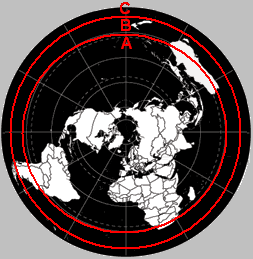
The result is that, from the perspective of the other side of the globe, unowned territory C is now a small circular area surrounded by doughnut B, while A comprises most of the earth’s surface. But does this shifting of boundaries obviate the obligation of B’s owner to allow access from A to C? I can’t see why it should. Surely mere relative size is not a decisive consideration; and what counts as imprisoning has little to do with which boundary is “inside” or “outside” the other. Recall the marvelous image that opens Ursula LeGuin’s The Dispossessed:
Like all walls it was ambiguous, two-faced. What was inside it and what was outside it depended upon which side of it you were on.
Looked at from one side, the wall enclosed a barren sixty-acre field called the Port of Anarres. … The wall shut in not only the landing field but also the ships that came down out of space, and the men that came on the ships, and the worlds they came from, and the rest of the universe. It enclosed the universe, leaving Anarres outside, free.
Looked at from the other side, the wall enclosed Anarres: the whole planet was inside it, a great prison camp, cut off from other worlds and other men, in quarantine.
So anyway, those are my initial reactions.
Roderick, imagine a guy who owns an acre of land in Kansas. He’s surrounded by a patchwork of millions of tracts of land owned by other private owners. Say he wants to go to France. The only way to get there is to get permission to cross over the property of thousands of others. What if none of them grant it? Then does he have an easement over any property he selects, even though he doesn’t need it (he only needs a few). If he only has one easement-route, that seems arbitrary.
You can imagine the donut is owned by 100 people. Cross any of their tracts gets him in or out. Which one does he have an easement over?
Or how about this. Imagine a fully-owned planet. I want to fly to Jupiter. I can build a rocket, but I don’t own enough land to place it on. I need a 100 acre tract to use as a takeoff pad. No one will sell me their land. Do I have a “rocketpad” easement on — someone’s? — property? Otherwise, they’re “trapping” me here on earth.
***
BTW, Roderick, you may find of interest some of the following, drawn from a previous comment I made on a libertarian list–
“the problem of enclosing others’ estates is not a new one that is the product of the imagination of libertarian theorists in their armchairs. It is a problem since antiquity and the law has found ways to deal with it. Maybe libertarian, maybe not, but one would think that one would want to be aware of and analyzie these practical solutions which were found by people trying to find a just solution to an apparently conflict of property rights. Why we think we would be any better at it than them, I don’t know, assuming their attempt to solve the problem was not based on any non-libertarian premises or rationales. In short, maybe we can lean something from history? Maybe a study of continental civil codes, or the Roman law, or the common law, might prove fruitful? If a libertarian society were achieved, do we think judges faced with difficult decisions might not read up on what judges 500 years ago did in similar cases?
Now: as an example: see articles 689 etc. of the Louisiana Civil Code (
http://www.legis.state.la.us/lss/lss.asp?folder=222 ) — this contains
codified legal principles roughly based on those developed over centuries in
the Roman law (see arts. 693-94 especially)
Art. 689. Enclosed estate; right of passage.
The owner of an estate that has no access to a public road may claim a right
of passage over neighboring property to the nearest public road. He is
bound to indemnify his neighbor for the damage he may occasion.
Art. 690. Extent of passage.
The right of passage for the benefit of an enclosed estate shall be suitable
for the kind of traffic that is reasonably necessary for the use of that
estate.
Art. 691. Constructions.
The owner of the enclosed estate may construct on the right of way the type
of road or railroad reasonably necessary for the exercise of the servitude.
Art. 692. Location of passage.
The owner of the enclosed estate may not demand the right of passage
anywhere he chooses. The passage generally shall be taken along the
shortest route from the enclosed estate to the public road at the location
least injurious to the intervening lands.
Art. 693. Enclosed estate; voluntary act.
If an estate becomes enclosed as a result of a voluntary act or omission of
its owner, the neighbors are not bound to furnish a passage to him or his
successors.
Art. 694. Enclosed estate; voluntary alienation or partition.
When in the case of partition, or a voluntary alienation of an estate or of
a part thereof, property alienated or partitioned becomes enclosed, passage shall be furnished gratuitously by the owner of the land on which the passage was previously exercised, even if it is not the shortest route to
the public road, and even if the act of alienation or partition does not
mention a servitude of passage.
Art. 695. Relocation of servitude.
The owner of the enclosed estate has no right to the relocation of this
servitude after it is fixed. The owner of the servient estate has the right
to demand relocation of the servitude to a more convenient place at his own
expense, provided that it affords the same facility to the owner of the
enclosed estate.
Hi Stephan,
Which one does he have an easement over?
I’m inclined to think: whichever one he likes, unless the owners come to some other agreement. You have a right to defend yourself against a rights-violation, whether the rights-violator is an individual or a group.
I’ll ponder your further questions when I’m less sleepy.
Thanks, er, Administrator. 🙂 And see the Mises comment thread–I added lots of claritude there.
Thanks, er, Administrator.
Ya better believe it:
I think Kinsella has proven that I have an absolute right to 100 acres of land whenever I want to build my rocketship, but not before. 🙂
Reading Dr. Long’s claims, I think I see how easements work. If you’ve landlocked property A by building a donut property B, then people have a right to trespass if they have to cross B for 1) food & water, 2) clothing, 3) vacations to France. They have no easement and hence no right to trespass if they want to 1) develop A as a vacation resort, 2) vacation to Mars, or 3) hit the mall and hang out.
I’m having an Azandean Witch moment. On the one hand, I can’t find any specific inferential flaw, but the notion that you have the right (and thus the right to use force to assert that right) to use someone else’s property simply because you want to (which is how this idea boils down in my mind) troubles me greatly.