Guest Blog by Jennifer McKitrick
[cross-posted at JenMc’s Blog]
It seems to me much of the criticism about executive compensation has been misplaced.
What’s supposed to be so horrible about CEO’s getting big bonuses?
- “They just don’t get it.”
- “They’re idiots.”
- “They don’t understand that people are hurting and angry.”
- “They’re insensitive to public perceptions.”
That might be true. But is that really the problem? Is that what’s important – whether or not CEO’s know or care what we think?
- “They don’t deserve it.”
- “It’s rewarding failure.”
OK, imagine this… Suppose that certain executives at these companies had been working really hard, doing their best, etc., etc. And let’s even suppose they’re not the people who had made bad decisions, but they are doing their darnedest to repair the damage. And suppose we had good evidence that, if it weren’t for their work, things would be much worse. Given the circumstances, they might be described as moderately successful in their endeavors. Even if this were the case, how would you feel if millions of taxpayer dollars that was intended to help save their companies was used to give them bonuses instead? Myself, personally, would still not be happy about it. (I find it implausible that the bonuses, in the current environment, actually help the company be more profitable.)
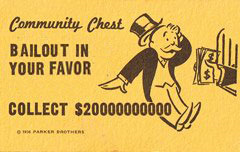 On the other hand, suppose that a private company that has taken no bailout money decides to give a reckless and irresponsible executive a multi-million dollar bonus that he doesn’t deserve. This might be a bad idea for many reasons. It will probably be bad for the company, and in turn, bad for everyone who depends on that company. But, hey, if they want to shoot themselves in the foot, that’s more or less their problem. Investors and other people who depend on this company should be aware and take caution. If such practices are harmful to companies, companies that are determined to engage in them should fail.
In sum:
Bonuses for well-meaning, “deserving” executives for bailed out companies – Grrr!
Bonuses for reckless, undeserving executives for private (un-bailed-out) companies – Oh well.
Ergo: The executives’ being undeserving is irrelevant to how bad an idea the bonuses are!
So why are the bonuses so horrible? In my opinion, it’s because they constitute the transfer of vast sums of wealth from millions of Americans who can’t afford it to a privileged few, which serves no other purpose than the interests of the few (who also happen to have been a lot better off in the first place).
Who cares what they do or don’t understand, what their motives are, or what they do or do not deserve? I don’t.
This has got to be the biggest rip-off perpetrated against the American people in the history of our country. And all people can complain about is that the beneficiaries of this scam are insensitive and undeserving?!
But if we stop talking about the character flaws of CEO’s, we’ll have to start talking about the people who just handed them billions of dollars that we don’t even have. I mean, it’s not as if they broke into Fort Knox and stole it.
- “This is a red herring. It’s such a small percentage of the bailout (or TARP or whatever) money. Complaining about it is great political theater, but in the big picture, the bonuses are irrelevant.”
OK. Here’s how to get away with wasting a billion dollars: First, spend a trillion dollars. Then, when someone asks about how a billion of it was spent, point out that that is only 0.1% of the total. (Recall that the same kind of response was made in defense of various parts of the stimulus package. It is so huge that to complain about multi-billion dollar expenditures looks like knit-picking.)
The sums of money here are just beyond my comprehension. But I’m not supposed to worry about amounts that are far more than I could earn in 10 lifetimes, because it’s a drop in the bucket of what the U.S. taxpayers are on the hook for. And this is supposed to make me feel better why?
Jennifer McKitrick is Associate Professor of Philosophy at the University of Nebraska – Lincoln, and Vice-President of the Molinari Institute and Molinari Society.
Roderick,
On a related note of economic compensation:
I like some of the stuff on Lew Rockwell’s site…
That said, I just saw an article headline that read: “equal pay for equal work: what’s that mean?”
Seems like an easy to understand concept to me!
Jennifer,
Great post! I am getting emails about protesting the AIG bonuses. What about protesting all of the Congress people who robbed us commoners? Every extra hour we will have to work to pay off the national debt in the future is corporate statist imposed slavery.
Hmph
I completely agree that the bailouts are truly ghastly and that they deserve to receive the lion’s share of negative attention.
But I’m not sure I follow your other argument. If bonuses are all-things-considered harmful to companies then (whatever other issues might reasonably be on the table) it seems as if this is, precisely, relevant to how bad an idea awarding them is. By all means, let’s end the bailouts. But why not object to stupidity, inefficiency, and unfairness wherever they occur?
I doubt that bonuses are, in general, harmful to companies, but anyway, I was being somewhat vague in suggesting that giving privately funded undeserved bonuses is not a bad idea. Of course, if it is bad for the company, under some description, it is a bad idea. And if it’s a public company, they’re doing wrong by their shareholders. What I was more concerned about, however, is behavior that warrants my resentment. I can find bad business practices to be criticizable, but not feel as though I have been wronged.
Many of the “person-on-the-street” reactions seem primarily concerned with the great discrepancies of wealth between the bonus-recipients and themselves. I agree that all of these features of the situation make it more aggravating, but if it’s economic inequality that’s at issue, why is their anger is focused on AIG? And why now? Are these people just finding out about millionaires? I suggest it’s not just what the executives have, but where it came from.
I heard some remarks the President Obama made this morning, reminding Republicans that they opposed placing limits on executive compensation when he talked it about during the campaign. But that was before all the bailouts. Like many people commenting on this issue, he fails to distinguish between compensation funded by profits and compensation funded by taxes. Perhaps I am naive to think there is still a difference that makes a difference.
I agree wholeheartedly, Jennifer, that there is a morally significant distinction between bonuses funded by bailouts and ones funded by profits. The former are surely objectionable in principle, while objections to the latter need to be sorted out on a case-by-case basis. My point was only the limited one that there might be a pragmatic or moral objection to a given bonus–its being funded by profits doesn’t necessarily exclude it from practical or normative assessment.
I think Jennifer has managed to articulate what most people are trying to think when they say things like “They just don’t get it,” “they’re insensitive,” and so on. What they “just don’t get” is the absurdity, both economically and morally, of using taxpayers’ money to give perks to people who are already well-paid and whose bonuses will certainly do nothing to help their companies recover. It hardly matters what one thinks about the bail-outs in principle: even if there’s nothing to object to in giving the companies bail-out funds, there’s surely much to object to in those companies using that money to give bonuses to people who are, in general, already paid far more than they need to live ludicrously luxurious lives.
So hooray. I still don’t know exactly what to think about the bail-out funds in general, but I’m quite certain that the bonuses “constitute the transfer of vast sums of wealth from millions of Americans who can’t afford it to a privileged few, which serves no other purpose than the interests of the few (who also happen to have been a lot better off in the first place),” and that this is both unjust and economically irresponsible. My only reservation is with the idea that the usual criticisms aren’t really motivated by precisely that judgment, even if they are stupidly expressed.
Count on right-wingers (libertarians included) expressing concern over the popular reaction to this. For example, Omar Abu Hatem at the Western Standard Shotgun blog says, “The frightening aspect of this entire situation is the particular disgust at the large amount of the bonuses which go against the entire concept of subjective prices and the freedom of voluntarily agreeing upon the price of labor…It is the private sector who should be mad at the government, and not vice versa.”
Really? *That’s* the frightening aspect? And this is from someone who also says, in the very same post: “AIG would not be a government-instituted monopoly and in this situation if it was allowed to fail freely instead of being socialized and supported by the U.S. federal government which has taken by force taxpayer dollars from its citizens and used them for unconstitutional purposes antithetical to the very notion of limited government.”
Arguments from the *more* statist conservatives are not even worth addressing.
Well, assuming that government’s bad economic judgment is enabled and/or demanded by the popular bad economic judgment it seems reasonable to be more frightened of the root cause than the effect.
I don’t necessarily want to endorse the premises, but I’m just saying that it follows.
“So why are the bonuses so horrible? In my opinion, it’s because they constitute the transfer of vast sums of wealth from millions of Americans who can’t afford it to a privileged few, which serves no other purpose than the interests of the few (who also happen to have been a lot better off in the first place).”
Ummmm, isn’t that what the bailout money was in the first place? Personally, I never had to go as far as the bonus to reach this level of outrage. It’s really a mere annoyance at this point … kind of like being tickled with a feather immediately after being gored by an ox…
“isn’t that what the bailout money was in the first place?”
It might have been what it was, but not what it was supposed to be, not what it was sold as. It’s ostensive purpose was to “save the economy.” Regardless of it’s prospects for succeeding at that, there’s something extra special about a transfer of wealth that not even Obama can put a positive spin on.
Jennifer, I’m afraid I don’t follow your argument. Clearly the bailout itself was a moral outrage. However, for a given amount of bailout funding, I don’t see why this particular use of funds is worse than others. Paying executive bonuses did not increase the total amount of the taxpayer subsidy. If AIG had used its bailout money to pay higher wages, or build new facilities, or hold a big office Christmas party, would you be equally outraged? Why are executive bonuses per se illegitimate?
The key question, it seems to me, is whether these particular bonuses are likely to increase the value of the firm. Without knowing which executives got what, how the bonus amounts were determined, what was in each employment contract, what’s going on in the relevant external labor markets, and so on, there’s no way to tell. (And none of that has been made public, so we don’t know.) You say, quite casually, that “I find it implausible that the bonuses, in the current environment, actually help the company be more profitable,” but you don’t offer any argument or evidence.
The broader question is whether, given that the bailout funds have been dispersed, it’s appropriate for taxpayers to intervene in the day-to-day management of the firm. Are all operational and strategic decisions up for external review?
Of course, AIG should never have been bailed out, but should have been allowed to go bankrupt. It would then be up to the bankruptcy court to review existing contracts (not just with executives but with workers, suppliers, customers, etc.) and figure out which contracts would be honored and how. But given that the firm was bailed out, I don’t see why some contracts should be breached, simply to appease grandstanding politicians.
My own views are here: http://organizationsandmarkets.com/2009/03/19/thoughts-on-aig/
It’s kind of funny that Gary Chartier and Peter Klein seem to be interpreting Jennifer’s argument in precisely opposite ways. Peter wants to know why she thinks there is, and Gary wants to know why she thinks there isn’t, something wrong with the bonuses over and above their being tax-funded.
I don’t know why everyone is focusing on AIG’s bonuses (as opposed to Meryl Lynch’s, or office renovations, etc.). There have been many other abuses recently that have been just as bad. I was just looking at this one example that caused so much OUTRAGE!!!, and was struck by how the criticism seemed off-point. Anyway…
I watched AIG’s new CEO testify yesterday, and I was convinced that he thought that awarding the bonuses, given that the contracts had already been made, was in the best interest of the company. But he also said that he wouldn’t have made those contracts in the first place. I’m open to the possibility that huge bonuses are good for companies sometimes, and I admit that I don’t know enough about these things to be sure when that is. Why do I doubt that bonuses were good for this company in this case? Lots of people who work in the financial industry have been laid off recently. If AIG employees weren’t given retention bonuses, they might have stayed because they have no where else to go, or they could have been replaced. And also, they could have (and Liddy indicated that they did) anticipate the public reaction, and, as he explained, this has severely damages their brand and their prospects of getting further government assistance. I could be wrong, but that’s my reason.
I don’t think the bonuses are more horrible than the whole bailout, but for me, it was salt in the wound (more than just a tickle.)
Executives at bailed-out companies deserve bonuses. I don’t see how these cretins have failed. Sure, they ran their companies into the ground with their stupidity and incompetence, but they also managed to keep their companies running. The fact that they did so by partnering with the thieving bastard Political Class is irrelevant. They kept their companies running by a massive, but legal, conspiracy to rob the taxpayers. They snatched victory from the jaws of a self-inflicted defeat. That deserves a bonus. If the sheeple don’t like it, maybe they should stop whining about it and do something to stop the bailouts.
Great satire. I love it!
The executives receiving bonuses have paid a lot of taxes in their life. Even if the bonus they receive is TARP money, I think they are still net tax victims. They’re merely getting back the money that was extorted from them in the first place.
Given the extent of govt. support, direct and indirect, for big business, it’s not obvious that the executives are net tax victims. (Note — I’m not saying that they’re not, I’m just saying that it’s not obvious that they are.)
To add to what Roderick said, it seems clear that the financial sector in particular is a major beneficiary of govt. subsidies.
Roderick, I suppose it depends on one’s starting point!
The title of my post was not meant to be imperative, but…
A couple of people have objected to my “argument” but no one has said anything to challenge the conclusion, which was that much of the criticism of the bonuses in the media has been misplaced. If anything, others seem to think that it is misplaced for reasons other than those I mention. I have no problem with popular criticism being misplaced for multiple reasons. I guess the counter-argument I can’t accept is that popular criticism of the bonuses is misplaced because there’s nothing wrong with them. I might accept the premise that “if the bailouts are permissible, then the bonuses are permissible,” however, since all parties to this discussion seem to reject that antecedent, that’s not a point of contention.
Also, we got into this debate about whether or not the bonuses were deserved, when one of my main claims in my argument was desert is irrelevant. (See claim in bold.) So, I really have no stand on whether the bonuses were deserved in this, or in any other case. I don’t think desert has much to do with entitlement anyway.
I do happen to think that the bonuses were bad for AIG, but that’s not central to my argument either. That claim would be important to my argument only if you accept that premise that what’s good for AIG is good for taxpayers. Anybody want to stand up for that one?
Also, it was no part of my argument that the bonuses were the worse than the bailouts in general. In fact, as I tried to suggest, it’s the scope of the bailouts that makes particular criticisms against the bonuses seem especially lame. When I opined that this might be “the biggest rip-off perpetrated against the American people,” I might have been speaking hyperbolically but I wasn’t talking about a mere 12.5 million dollars. We’ve been ripped off for a lot more than that, obviously.
“Many of the “person-on-the-street” reactions seem primarily concerned with the great discrepancies of wealth between the bonus-recipients and themselves. I agree that all of these features of the situation make it more aggravating, but if it’s economic inequality that’s at issue, why is their anger is focused on AIG? And why now?”
JenMc, it’s like this. There has to be some common focal point for people’s anger– yes, it is somewhat arbitrary, but it has to be focussed somewhere. It’s like when a dike weakens under tremendous pressure and finally cracks and starts to give out, one can ask, why did the first cracks appear exactly where they did? There’s no logical reason, a priori, why the wall first starts to crack in one place and not another– but something has to give.