Lovecraft famously described “the inability of the human mind to correlate all its contents” as a merciful protection against the “terrifying vistas of reality” that would otherwise be opened up by “the piecing together of dissociated knowledge.”
 Well, my own recent correlations haven’t laid bare any terrifying vistas yet, but they have led me to some interesting connections. A reference in David Reynolds’s biography John Brown, Abolitionist (yes, I’ve been reading several Brown bios lately) sent me to hunt down this speech by pro-slavery Senator John Townsend, in which he asserted inter alia:
Some months before the Abolition raid in Virginia, old John Brown, H. Kagi, and others, had put forth at the North a “Plan for the Abolition of Slavery,” for the purpose, as they stated, of “forming Associations throughout the country of all persons who are willing to pledge themselves publicly to favor the enterprise, and render support and assistance of any kind.”
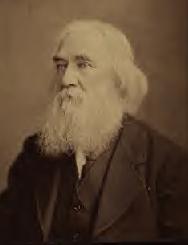 Reynolds apparently accepts the attribution to Brown’s group. But to a Lysander Spooner fanatic like your humble correspondent, it’s obvious from the line Townsend quotes that the work he is citing is this piece by Spooner, and not anything by John Brown at all. As Spooner mentions in this letter, when John Brown learned of Spooner’s manifesto he actually requested that Spooner withdraw it from circulation – not because he disagreed with it but because it was a bit too close to what Brown was already planning to do at Harpers Ferry. (Spooner would later attempt, unsuccessfully, to organise a plot to rescue Brown from execution by kidnapping the Governor of Virginia.)
Digging a little deeper, I discovered that the mistaken attribution of Spooner’s circular to Brown turned out to win him some money. As Spooner’s biographer explains:
Ironically, Spooner came into some money through a strange libel suit prosecuted by Gerrit Smith. The New York Democratic Vigilant Association (Buchanan supporters) attempted to blame John Brown’s attack on Smith, to whom they attributed Spooner’s 1858 manifesto, “Plan for the Abolition of Slavery.” … Gerrit Smith sued them for libel because they had falsely linked him with Spooner’s broadside …. It was true that Smith had contact with John Brown [In fact he was one of Brown’s chief financial donors. – RTL], but the evidence the Association used to prove an alliance was largely false. Smith retained several attorneys in the case, but Lysander Spooner was his chief lawyer. By his own testimony, Spooner was in the best position to prove the falseness of charges against Smith. … The Vigilant Association had made their accusations in the hopes of discrediting the Republican party and particularly William Seward, the Republican candidate for governor. Once the election had ended with Seward’s victory, they were eager enough to settle out of court. Smith settled for costs and lawyers’ fees – most of which went to Spooner. The two thousand dollar fee was a minor fortune for him since he managed to live on about two hundred dollars a year.
And who is Gerrit Smith? The same guy whose book The True Office of Civil Government was the subject of Laurence Vance’s talk at the last ASC.
While I’m (sort of) on it, what should libertarians think of John Brown? Rothbard revered him; many Rothbardians today despise him. My take: the Pottawatomie massacre wasn’t justified; the victims weren’t close enough to being genuine combatants. The Vernon County raid was eminently justified; the Harpers Ferry raid would likewise have been justified if it had been planned a bit better – its flaws weren’t mainly moral ones. I think Spooner’s circular states the case for the John Brown approach pretty well – and if slavery had ended through Brown/Spooner-style slave insurrections rather than through Union occupation, the liberated blacks would have avoided a hundred years of Jim Crow, and the country as a whole would have avoided the bloody Lincoln-Davis war (how much worse could slave insurrections have been?) and the federal centralisation consequent thereon.
 [cross-posted at
 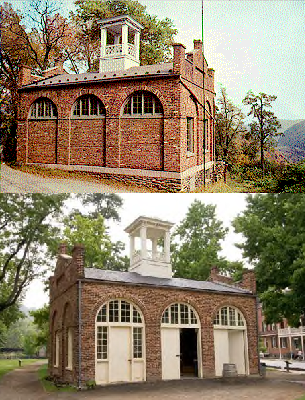 The engine-house at Harper’s Ferry [cite of John Brown’s last stand against Federal troops] was bought by a group of speculators, taken apart, and then reassembled at the Chicago World’s Fair in 1893 where it was exhibited as John Brown’s Fort. … After the fair, the building was repurchased and set up on a farm on the Shenandoah, two miles from Harper’s Ferry. Later it changed hands again and was located at Storer College at Harper’s Ferry, a Negro college founded there in 1867. Again it was moved in the town and today, a great tourist attraction, it stands near the Shenandoah Bank, not far from the Potomac bridge which Brown crossed on the night of October 16, 1859, but closer to the arsenal site than to the armory. In all these transplantations and relayings of bricks it may not be the same building since it is probable that the dimensions of the original structure have altered and, indeed, some of the bricks may have been lost.
 Baltar: What of our bargain? My colony was to be spared!
 Ralph Waldo Emerson commenting on the not so wild wild west:
 Once we take the passage in the context of the Venus series as a whole, the first interpretation quickly becomes ludicrous. The Venus series represents a sustained satire of authoritarians and collectivists of all varieties, including Communists (“Thorists”), Nazis (“Zanis” whose obsession with “keeping the blood of Korvans pure” is ridiculed), and eugenicists (the people of “Havatoo,” who find the narrator genetically unfit and condemn him to die). Broaden the context still further, to recall Burroughs’s poem “The Black Man’s Burden,” parodying Kipling’s “The White Man’s Burden”; Burroughs’s satirical reversal of white supremacy in novels like