Ever the man in men! Let a woman know her proper place: let her milk and spin and sew and bear children, not look beyond her threshold or the command of her lord and master! Bah! I spit on you! There is no man alive who can face me with weapons and live, and before I die, I’ll prove it to the world. Women! Cows! Slaves! Whimpering, cringing serfs, crouching to blows, revenging themselves by – taking their own lives, as my sister urged me to do. Ha! You deny me a place among men? By God, I’ll live as I please and die as God wills, but if I’m not fit to be a man’s comrade, at least I’ll be no man’s mistress. … Better a short life of adventure and wild living than a long dreary grind of soul-crushing household toil and child-bearing, cringing under the cudgel of a man I hated.
– Dark Agnes, in Robert E. Howard, Sword Woman
A quick follow-up to my Pictish post:
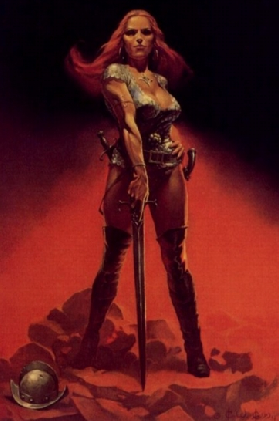 Robert E. Howard was certainly no feminist; women in his stories exist mainly to be rescued or to be ravished, or both (and often both by the hero). But toward the end of his writing career he experimented more and more frequently with increasingly strong and independent female heroines. A first glimmer comes with the character of the pirate Helen Tavrel in his 1928 story “The Isle of Pirate’s Doom”; Tavrel starts out as a tough warrior, but ends up a weepy rescue object – a fairly typical arc in genre fiction even today (recall Maid Marian’s character arc in the Kevin Costner Robin Hood). Still, the story does present a mostly-independent heroine favourably; it was a start.
And then came the period 1934-36, the last three years of Howard’s life, and the years in which he created his four most memorable heroines: Belît in “Queen of the Black Coast,” Valeria in “Red Nails” (no, it’s not a reference to nail polish – nor, surprisingly enough, to blood either), Red Sonya (not to be confused with the chainmail-bikini-wearing comic-book character Red Sonja, who was inspired by both Sonya and Agnes, but not created by Howard) in “Shadow of the Vulture,” and Dark Agnes in “Sword Woman,” “Blades for France,” and the unfinished “Mistress of Death.” (It’s regrettable that the Dark Agnes stories, the most feminist of the lot, aren’t online. They can be found in the now out-of-print anthology Sword Woman – which includes the abomination of Gerald Page’s attempt to complete “Mistress of Death.” If you didn’t know where Howard stopped and Page started – for the record, Page takes over with the paragraph beginning, appropriately enough, “Stuart led the way” – it would be easy enough to guess, since Agnes’s character abruptly goes from confident and assertive to timid and passive. A new – and hopefully Page-less – Agnes anthology is in the works from Wandering Star.)
 Why this sudden turn to powerful heroines in 1934-36? Some have suggested the possible influence of Howard’s independent-minded friend Novalyne Price, whom he got to know during this period; others have pointed to the possible impact of the Jirel of Joiry stories of C. L. Moore (which in turn were influenced by Howard’s earlier work); we know that Howard praised Moore and sent her a copy of “Sword Woman,” which she liked.
Howard also seems to have taken pains to differentiate his four warrior women from one another rather than imposing a single stereotype on them all. Some are grim, others cheerful; some cautiously thoughtful, others rashly impulsive; some straightforward, others devious; some sexually aggressive, others resolutely celibate. Only one, Dark Agnes, is in self-conscious rebellion against patriarchy per se (it’s often been observed that if the Dark Agnes stories had been written by a woman, she would have been accused of being a “man-hating feminist”), and her tales are moreover the only ones in which the female lead has center stage rather than sharing equal billing with a man.
Valeria’s status as Conan’s sidekick, in constant need of rescuing – from, inter alia, a lesbian vampire – somewhat weakens her status as heroine (though she is certainly more self-sufficient than Helen Tavrel); but Belît is closer to being Conan’s equal partner, while Sonya and Agnes are more likely to be rescuing other people than to require rescuing themselves. With all the different Howard anthologies coming out these days, it would be nice if someone were to collect his various warrior-women tales (Helen Tavrel, Belît, Valeria, Sonya, Agnes, and any others I’ve missed) in a single volume.
Edit:
Oh, I’ve remembered another — Ayesha in “Road of the Eagles.” I didn’t initially think of her because, although she’s handy with a knife, she’s not strictly a “warrior woman,” at least by profession; instead she falls into the category of “scheming slave girl,” a role usually assigned in genre fiction of this period either to villains or to rescue/ravish objects. But Ayesha is neither; she’s a sympathetically portrayed, courageous woman, with a cool head and an iron will, who makes all the plans as her male lover tags along in a daze. In keeping with Howard’s avoidance of fitting all his heroines into a uniform mold, Ayesha does it all out of love for her male rescue object , giving her a different motivation from all the others.

 First we were told: if Edwards had been the nominee when his affair was revealed, it would have handed the election to McCain!