I just saw an ad for a 1999 production of David Copperfield (the Dickens waif, not the stage magician or the anarcho-syndicalist assassin – oops, you’re not supposed to know about the anarcho-syndicalist assassin), starring a very young Daniel Radcliffe. I was amused to see Maggie Smith (Prof. McGonagall) as David’s Aunt and Imelda Staunton (Dolores Umbridge) as Mrs. Micawber. Making the Potter movies must have felt like a reunion.
Archive | 2009
Making the Grade
There’s a famous story about Fred Smith at Yale submitting for class a business plan for what would one day be Federal Express, and getting it back with a C and a comment from the professor: “The concept is interesting and well-formed, but in order to earn better than a ‘C’, the idea must be feasible.”
 That’s such a delightful story that it really ought to be true; but here’s what Smith himself says about it:
The first phase really started when I was an undergraduate at Yale in 1965. I wrote a term paper for an economics class in which I simply observed that as society became more automated, companies like IBM and Xerox that sold early computer devices needed to make sure that their products were dependable. … How do you get your computer parts quickly when your system goes down? You couldn’t depend on the post office. I believed you’d need a faster, more dependable, and more far-reaching kind of delivery system. That’s what the paper was about; it was not a full-blown business plan.
Today that paper is kind of famous, and it’s because of a careless comment I once made. I was asked what grade I got on it, and I stupidly said, ‘I guess I got my usual gentlemanly C.’ That stuck, and it’s become a well-know story because everybody likes to flout authority. But to be honest, I don’t really remember what grade I got it. I probably didn’t get a very good one, though, because it wasn’t a well-thought-out paper.
From which I infer that the famous quotation (never attributed to any professor by name) is, alas, inauthentic.
Myths About Myths
Mythconception #1 (Greek): The Trojan Horse is in the Iliad.
Even Daria fell for this one, in the episode when she tried to get her younger sister to read the Iliad:
DARIA: Try this. I think you’ll get into it.
QUINN: Ha, ha, very funny. Now give me something that I can read.
DARIA: No, I think you’ll like it. It’s about this girl who’s so popular that everybody fights over her.
QUINN: Any horses in it?
DARIA: As a matter of a fact, there’s a great big one.
QUINN: This is a trick, isn’t it?
DARIA: Yes.
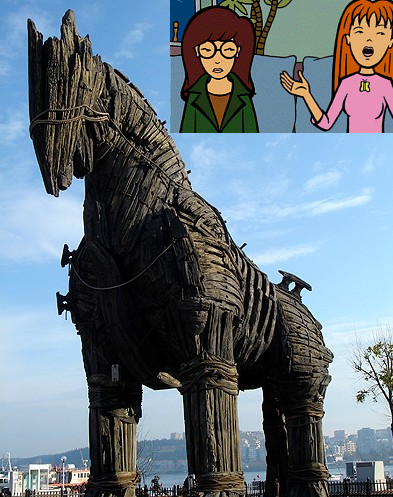
But in fact the Iliad isn’t an account of the entire Trojan War; it starts nine years after the beginning of hostilities, and ends while the war is still going on – too soon to include the Trojan Horse. (The horse does get a brief mention in Homer – but in the Odyssey, not the Iliad; our fullest info on the Horse comes from such post-Homeric sources as Triphiodorus, Vergil, and Quintus of Smyrna.)
Mythconception #2 (Norse): All heroic Viking warriors slain in battle go to Valhalla.
Nope. Only half go to Valhalla; the other half go to a lesser-known – but apparently equally desirable – hall called Sessrúmnir (“many-seated”) in Fólkvangr (“field of warriors”), presided over by the goddess Freyja. The principle of selection is unclear.

Mythconception #3 (Hebrew): Noah took two of each kind of animal onto the ark.
Not according to Genesis. True, God does initially tell Noah to bring two of each kind (Gen. 6: 19-20), but God soon goes on to clarify that Noah should actually take seven of each kosher animal, and two only of the non-kosher ones (Gen. 7: 2-3). (I guess this answers the question of what Noah and his family ate while they were in the ark.) [Updated: I am an idiot. Of course that should be seven pairs of each kosher animal – though now I wonder whether he was also supposed to take two pairs for the non-kosher ones.]

To be sure, the Genesis account appears to have been put together from at least two different sources, one of which simply says two of each kind and calls God Elohim, while the other offers the seven-kosher-and-two-not rule and calls God Yahweh; but in Genesis as we have it, the final word seems to be seven-kosher-and-two-not.
Mythconception #4 (Hindu): Once Rama rescues his kidnapped wife, they live happily ever after.
Not so much. Because Sita has been living in another man’s house, the presumption is that she has been unfaithful to her husband. Rama knows this presumption to be false, but as a king he values public opinion more than he values Sita – Caesar’s wife must be above suspicion, so to speak – and so, despite having spent the entire massive epic trying to get his wife back, once he does so he sends her into exile. It’s as though Odysseus had showed up on Ithaca and said to Penelope: “Hi honey, I’m home. Love ya. Now get off my island.”

Mythconception #5 (Celtic): The sword in the stone was named Excalibur.
Monty Python sadly leads us astray here:
OLD WOMAN: Well, how’d you become king, then?
ARTHUR: The Lady of the Lake, her arm clad in the purest shimmering samite, held aloft Excalibur from the bosom of the water, signifying by Divine Providence that I, Arthur, was to carry Excalibur. That is why I am your king!
DENNIS: Listen, strange women lying in ponds distributing swords is no basis for a system of government. Supreme executive power derives from a mandate from the masses, not from some farcical aquatic ceremony. … You can’t expect to wield supreme executive power just ’cause some watery tart threw a sword at you! … I mean, if I went around saying I was an emperor just because some moistened bint had lobbed a scimitar at me, they’d put me away!

But at least in most of the earliest versions of the story, these are two different swords: the sword that Arthur drew forth from the stone to establish his legitimate claim to the throne was never named, while Excalibur was a different sword that Arthur got from the Lady of the Lake after he was already king.
I Can’t Believe I Never Noticed This Before
Roderick TraCY LONg.
Coincidence or conspiracy?
Not Everyone Fears the Coming of the Black Freighter
This translation of the lyrics isn’t the most accurate one, but it’s the one that inspired Alan Moore.
Sorry, No Death For You
Just heard NM Gov. Bill Richardson on Maddow explaining that one of his reasons for opposing the death penalty is that prison conditions are so awful in his state that imprisonment is actually a worse punishment than death anyway.
Well, I’m glad he opposes the death penalty, I guess; but this has got to be the worst argument ever for doing so.