[cross-posted at C4SS, BHL, and POT]
The long-awaited second issue of the Molinari Review (the Molinari Institute’s interdisciplinary, open-access, libertarian academic journal) is here! Nearly twice the length of the first issue!
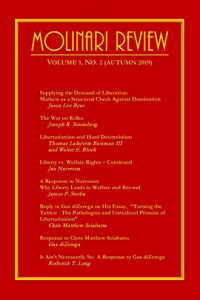
You can order a paper copy from Amazon US, Amazon Canada, Amazon UK, or, I believe, any of the other regional incarnations of Amazon.
(A Kindle copy should be available later this month. In the meantime, the previous issue is available as a free PDF download here.)
So what’s in the new issue? Here’s a rundown:
- Anarchist communists reject not only the state but the market as well, arguing that private property and market exchange are as much a source of domination as the instrumentalities of the state. In “Supplying the Demand of Liberation: Markets as a Structural Check Against Domination,” philosopher Jason Lee Byas argues, to the contrary, that individualist anarchism, precisely because of its reliance on markets and the greater plasticity they offer, satisfies the anarchist commitment to non-domination more successfully than communism does. Byas highlights the potential dangers of anarchist communists’ proposed alternatives to markets, arguing that these dangers become even more serious when the dynamics of race, gender, sexuality, and other systems of privilege and oppression are factored in, while the market process can be shown to be a powerful engine for addressing such problems.
- The economic regulations of the American Progressive Era have long been viewed – whether with approval or with disapproval, depending on the political perspective of the viewer – as a powerful blow against big business. In the 1960s, Gabriel Kolko and other New Left historians argued, to the contrary, that the corporate elite were the major beneficiaries of these regulations – a revisionist thesis soon enthusiastically embraced and promoted (much to the dismay of Kolko himself) by a number of free-market libertarian thinkers, including Murray Rothbard and Roy Childs. In recent years, however, Roger L. Bradley Jr. and Roger Donway have argued (see here and here) that Kolko’s account of the relationship between business and the state during the Gilded Age and its aftermath was flawed by a mistaken conceptual framework and a misleading use of evidence through selective quotation of his sources; for Bradley and Donway, what Kolko made to seem like corporate support for regulation was in most cases merely a matter of corporations adapting to regulation as a form of self-defense. In “The War on Kolko,” historian Joseph R. Stromberg defends Kolko against both the charge of misinterpreting the motives of corporate leaders and the charge of distorting the textual evidence, concluding that Kolko’s work remains “quite unscathed.”
- Is there any connection between liberty in the political sense and liberty in the sense at issue in the free will debate? John Stuart Mill, in the first sentence of his treatise On Liberty, famously replied in the negative. But in “Libertarianism and Hard Determinism,” Thomas Lafayette Bateman III and Walter E. Block argue that if a human being were “no more than a moist robot, subject completely to nature’s laws,” then political institutions to protect such an entity’s freedom of choice would be pointless, abstract principles of rights would be meaningless, and seeking to control individual behaviour through totalitarian manipulation and the judicious application of stimuli would seem optimal. Hence political libertarianism and hard determinism are incompatible; a consistent adherent of the first must reject the second.*
- For the past thirty years, philosophers Jan Narveson and James P. Sterba have been debating whether a commitment to liberty entails welfare rights or instead rules them out. For Narveson, those who acquire property by innocent means are entitled to it, and anyone who tries to take it from them without their consent is violating their liberty; whereas for Sterba, preventing the poor from making use of the excess property of the affluent is a violation of the liberty of the poor to access resources they need, which is a more important liberty than that of the affluent to maintain control of such resources. In “Liberty vs. Welfare Rights – Continued,” Narveson marshals the principles of Innocent Possession and Open-Ended Use to defend the right of the first user as more consonant with the requirements of peaceful and productive human cooperation than the right of the neediest user; in “A Response to Narveson: Why Liberty Leads to Welfare and Beyond,” Sterba argues that a more defensible formulation of the principles of Innocent Possession and Open-Ended Use instead favours the neediest user over the first user.
- In our previous issue, Gus diZerega argued that contemporary libertarians misunderstand and misapply their own key concepts, leading them to embrace an atomistic vision of society, and to overvalue the market while undervaluing empathy and democracy. The present issue features an exchange among diZerega, Chris Matthew Sciabarra, and myself on these matters, with particular attention to the interpretation of Ayn Rand, in contributions titled (from Sciabarra) “Reply to Gus diZerega on His Essay, ‘Turning the Tables: The Pathologies and Unrealized Promise of Libertarianism’,” (from diZerega) “Response to Chris Matthew Sciabarra,” and (from me) “It Ain’t Necessarily So: A Response to Gus diZerega.”
Want to order a copy? See the ordering information above.
Want to contribute an article to an upcoming issue? Head to the journal’s webpage.
Want to support this project financially? Make a donation to the Molinari Institute General Fund.
* Incidentally, I welcome Walter Block’s conversion to thick libertarianism – and look forward to his explanation of why his position here doesn’t really count as thick-libertarian. 😛