You can tell you’ve stumbled across a bit of pseudo-wisdom when its negation makes just as much sense as its affirmation.
 For example, I just saw a greeting card that said, “Anyone can be passionate, but it takes real lovers to be silly.” (A quick websearch reveals that this saying is all over the internet, and originated with the least remembered member of the Edna Ferber/Fannie Hurst/Rose Franken triumvirate.)
Well, slide that past your mind without thinking about it, and it sounds vaguely plausible. But slide the opposite claim past your mind without thinking about it – “Anyone can be silly, but it takes real lovers to be passionate” – and that sounds vaguely plausible too.
Inspect the two claims in a more attentive frame of mind, and suddenly neither one seems especially plausible. I suspect each gets its superficial plausibility from its resemblance to one of its much more reasonable cousins, namely, “Silliness is important between lovers” and “Passion is important between lovers.”
I also suspect that the original version was intended to have the charm of a Chestertonian paradox – but, well, it doesn’t. Perhaps it had more of that quality in the 30s or 40s, when it originated, than it does today, when it seems more bromidic; but it could never have had much.
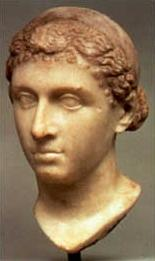 [H]er actual beauty … was not in itself so remarkable that none could be compared with her, or that no one could see her without being struck by it, but the contact of her presence, if you lived with her, was irresistible; the attraction of her person, joining with the charm of her conversation, and the character that attended all she said or did, was something bewitching. It was a pleasure merely to hear the sound of her voice, with which, like an instrument of many strings, she could pass from one language to another; so that there were few of the barbarian nations that she answered by an interpreter; to most of them she spoke herself, as to the Ethiopians, Troglodytes, Hebrews, Arabians, Syrians, Medes, Parthians, and many others, whose language she had learnt; which was all the more surprising because most of the kings, her predecessors [= the Ptolemies, i.e.Greek-speaking Macedonian conquerors], scarcely gave themselves the trouble to acquire the Egyptian tongue ….
 I’ve received several requests for the handouts that were, um, handed out to accompany my
  Tomorrow night Matthew Quest of the
  In the newest issue (20.3) of the