– I know what you’re going to say. You’re going to say, as so many of our enemies do, that you admire our ideals, but loathe our methods.
– I loathe your ideals. I admire your methods.
….. (Ayn Rand, We the Living, 1st edition.)
With a new Che Guevara movie on the way I thought it would be worth reviewing Rothbard’s shifting views on Che’s popularity.
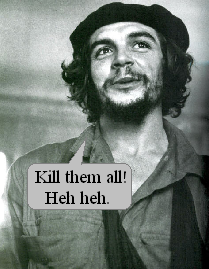 In 1967 Rothbard wrote:
Che is dead, and we all mourn him. Why? … Surely not because Che was a Communist. Precious few people in this country or anywhere else will mourn the passing, for example, of Brezhnev, Kosygin, or Ulbricht, Communist leaders all. No, it is certainly not Che’s Communist goals which made his name a byword and a legend throughout the world, and throughout the New Left in this country.
What made Che such an heroic figure for our time is that he, more than any man of our epoch or even of our century, was the living embodiment of the principle of Revolution. … And furthermore … we all knew that his enemy was our Enemy – that great Colossus that oppresses and threatens all the peoples of the world, U. S. imperialism.
Likewise a year later, commenting on the ’68 uprisings, Rothbard suggested that students revered Che – and also Mao – not because they were a Communist – since, again, Brezhnev was also a Communist and nobody revered him – but because Che and Mao had shown that in our “modern, complex, and militarized world” people are still “able to make revolution.”
Two more years later, however – in 1970 – Rothbard had moved to a less optimistic explanation for Che’s and Mao’s being more popular than Brezhnev, a shift corresponding to his increasing disillusionment with the left:
It is the communist ideal, the ultimate goal of Marxism, that excites the contemporary Marxist, that engages his most fervent passions. The New Left Marxist has no use for Soviet Russia because the Soviets have clearly relegated the communist ideal to the remotest possible future. The New Leftist admires Che Guevara, Fidel Castro, Mao Tse-Tung not simply because of their role as revolutionaries and guerrilla leaders, but more because of their repeated attempts to leap into communism as rapidly as possible. … The New Left, for example, ignores and scorns Marshall Tito despite his equally prominent role as Marxian revolutionary, guerrilla leader, and rebel against Soviet Russian dictation. The reason … is because Tito has pioneered in shifting from Marxism toward an individualistic philosophy and a market economy.
I have no particular dog in this fight; I think different leftists have admired Che for different reasons – some for the “good” reasons and some for the “bad” ones. I also think Rothbard went from an insufficiently selective engagement with the left in the 1960s (too willing to make nice with Maoists, for example) to an excessively broad rejection of the left in the 1970s, and may accordingly have passed in tandem from an excessively rosy interpretation of Che’s popularity to an excessively bleak one.
To me Che is no more than a would – be Hitler or Stalin. His anti-imperialism is analogous to Tim Mcveigh’s.
It sometimes seems as if Murray Rothbard was too willing to ignore the most odious aspects of potential allies (left or right,) and when he could ignore them no more he threw the baby out with the bathwater. Having never met the man (nor even heard of him until years after his death) this observation might be somewhat unfair, and if anyone can give a more accurate assessment of the matter I’d love to read it.
“Tito has pioneered in shifting from Marxism toward an individualistic philosophy and a market economy.”
Really?
“It sometimes seems as if Murray Rothbard was too willing to ignore the most odious aspects of potential allies (left or right,) and when he could ignore them no more he threw the baby out with the bathwater.”
He didn’t so much ignore them as bend over backward to pander to them.
Tito introduced some loosening of strict statist hierarchical economic organization in favor of worker cooperatives.
“On 26 June 1950, the National Assembly supported a crucial bill written by Milovan ?ilas and Tito about “self-management” (samoupravljanje): a type of independent socialism that experimented with profit sharing with workers in state-run enterprises.”
http://en.wikipedia.org/wiki/Josip_Broz_Tito#Tito-Stalin_split
I’ve long thought that Rothbard’s Che obit isn’t nearly as embarrassing as its reputation suggests. Once you get past the over-the-top tone (and the fact that there’s a long quote from Castro), Rothbard is surprisingly restrained and careful in what he actually praises about Che, and specifically says there’s not much value in Che’s politics and economics — saying that he’s “a notable revolutionary, but not a distinguished administrator, and even poorer as an economist” and that his economic blunders “almost wrecked the Cuban economy”. It’s also clear from Rothbard’s other writings that he found anarchist revolutionaries at least as congenial as Communist ones, such as May 68’s “heroic” Daniel Cohn-Bendit (indeed, saying that Obsolete Communism presents “[t]he case for an anarchist rather than a Bolshevik revolution”) and the Mexican Revolution’s Emiliano Zapata — note that, in fact, in this piece he compares Che to the “lovable” Bakunin. And it’s long been the case that those who considered revolution as a possibility in the modern world have crossed ideological lines to make their case — Carl Sagan once pointed to the anarcho-capitalist favorite “The Moon is a Harsh Mistress” as a work in which “useful suggestions can also be found for making revolution in a computerized technological society”.